Carbon Reduction Pathway
Carbon Reduction Pathway
Carbon Reduction Pathway
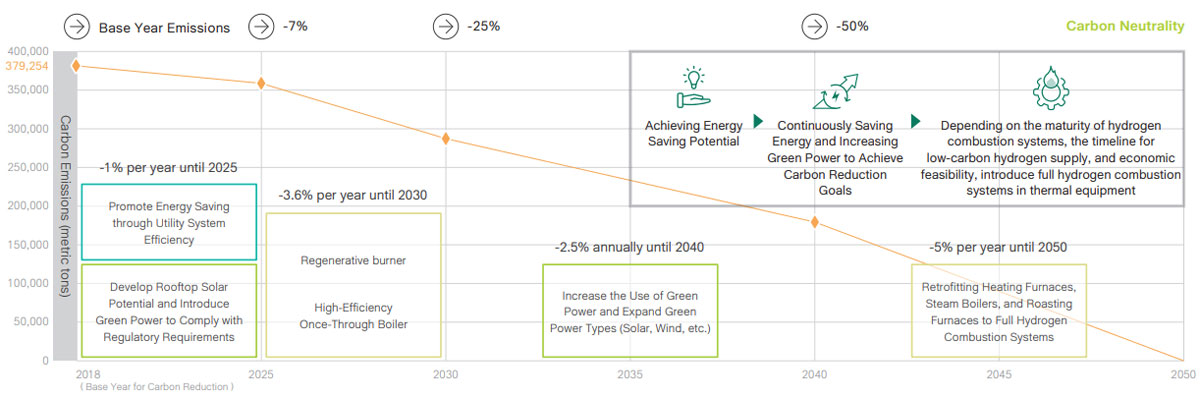
CHS's carbon reduction targets (Scope 1 and 2), using 2018 as the base year, and long-term carbon reduction targets and pathways are set as follows:
CHS's 2050 Carbon Reduction Pathway
- Short-term: 7% reduction compared to 2018 by 2025.
- Short-term: 25% reduction compared to 2018 by 2030.
- Medium-term: 50% reduction compared to 2018 by 2040.
- Long-term: Achieve carbon neutrality by 2050.
2050年減碳路徑圖如下:
CHS's 2050 Carbon Reduction Pathway
- 2025 Greenhouse Gas Emission Target: CO2e emissions ≦ 352,706 metric tons.
- 2024 greenhouse gas emissions totaled 238,943.691 metric tons, successfully meeting the target (CO2e emissions ≦ 356,499 metric tons).
2024 Major Energy Conservation and Carbon Reduction Initiatives and Performance
| Serial Number | Energy Conservation and Carbon Reduction Initiative | Energy Conservation Achievements | Carbon Reduction Achievements | |
|---|---|---|---|---|
| Electricity consumption (kWh) | GJ | CO2e(metric tons) | ||
| 1 | Energy-saving efforts have been driven by improving the efficiency of public utility systems (e.g., replacing LED lighting, phasing out old equipment, and upgrading equipment performance, with 33 projects completed). | 1,297,032 | 4,670 | 614.793 |
| 2 | Utilization of green electricity (totaling 6,274,531 kWh/year) | - | - | 2,974.128 |
- In 2024, the electricity savings from various energy efficiency projects were calculated based on the reporting method used in the Energy Administration's Energy Audit Network Declaration System. The calculations involved theoretical estimates (e.g., differences before and after equipment improvements) and actual electricity consumption measurements (using installed meters).
- The carbon emission reduction from energy efficiency projects in 2024 was self-estimated by CHS Corporation. It was calculated using the Energy Administration's electricity carbon emission coefficient of 0.474 kg CO2e per kWh for the year 2024.
- The carbon reduction outcomes for the current year: All fall under Scope 2.
Greenhouse Gas Inventory
Greenhouse Gas Inventory
CHS sets its organizational boundaries for greenhouse gas inventory according to operational control methods. Global Warming Potential (GWP) values are referenced from the Intergovernmental Panel on Climate Change (IPCC) Sixth Assessment Report (2021 edition), in compliance with the relevant regulatory requirements of the Financial Supervisory Commission's "Sustainable Development Roadmap for Listed Companies." The greenhouse gas inventory results for the past three years are as follows:
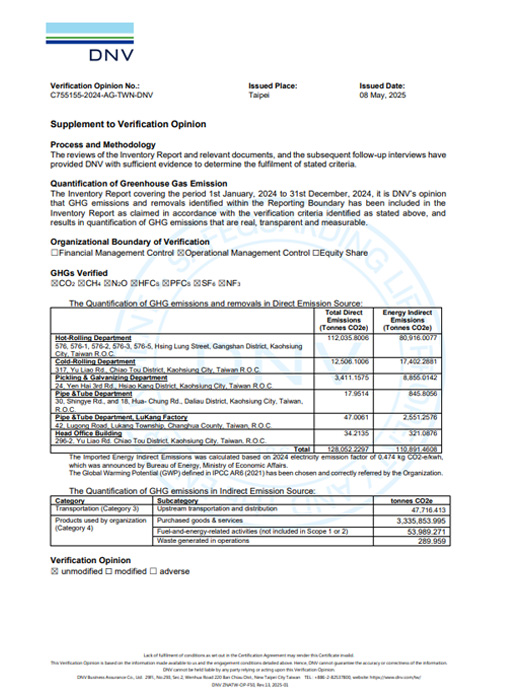
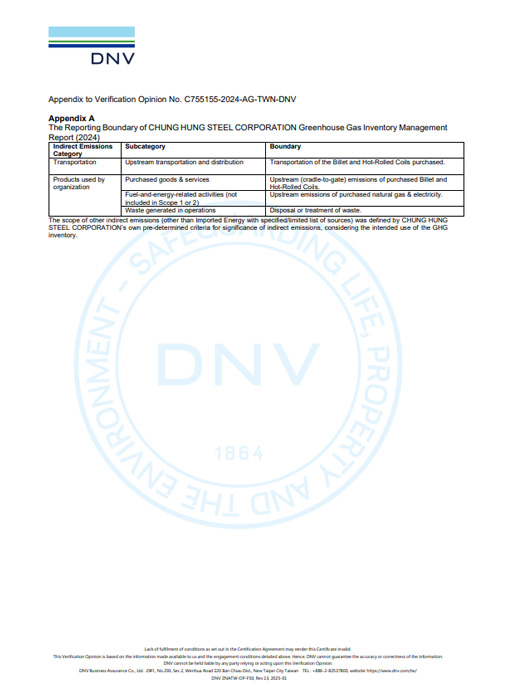
Unit: metric tons CO2e
| Scope 1 | Scope 2 | Scope 3 | ||||
|---|---|---|---|---|---|---|
| ISO 14064-1:2018 | Category1 | Category2 | Category3 | Category4 | Category5 | Category6 |
| 2022 | 142,063.9532 | 136,398.2775 | 62,161.4776 | 4,898,467.9797 | Due to the Company's production characteristics falling under category B→B, there are no activities falling under category 5. | - |
| 2023 | 146,771.5102 | 130,405.2627 | 59,160.3220 | 4,112,780.1530 | - | |
| 2024 | 128,052.2297 | 110,891.4608 | 47,716.4130 | 3,390,133.2250 | - | |
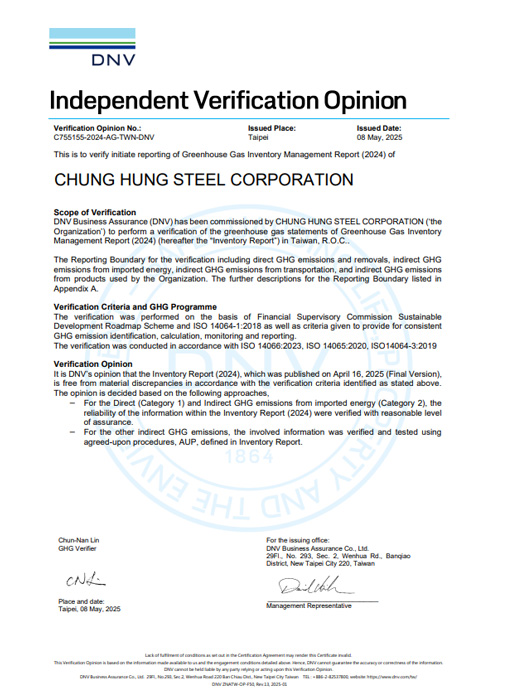
- The above GHG emissions data has been verified by an independent third party, DNV Business Assurance Co., Ltd. (DNV)—and certified under ISO 14064-1:2018.
- Types of greenhouse gases: Carbon dioxide (CO2), Methane (CH4), Nitrous oxide (N2O), Hydrofluorocarbons (HFCs), Perfluorocarbons (PFCs), Sulfur hexafluoride (SF6), Nitrogen trifluoride (NF3).
-
Definitions of emission sources for ISO 14064-1:2018 categories are as follows:
- Category 1: Direct Emissions
- Category 2: Indirect Energy Emissions
- Category 3: Indirect emissions from transportation (3.1 upstream transportation).
- Category 4: Indirect emissions from the use of products by the organization (4.1 purchased goods, 4.3 fuel- and energy-related activities, 4.4 waste disposal).
- Category 5: Emissions from the use of products by the organization.
- Category 6: Other sources.
-
Explanation of Scope 2 Emission Calculation Methods:
-
Location-based approach:
- Electricity purchased from Taiwan Power Company (Taipower) is calculated using the location-based approach, with the electricity emission factor adopted from the national grid emission factor announced by the Ministry of Economic Affairs.
- Steam purchased from China Steel Corporation (CSC) is also calculated using the location-based approach, with the emission factor for steam provided by the supplier (CSC).
- Market-based approach: Green electricity purchased from CSC Solar Corporation is calculated using the market-based approach.
-
Location-based approach:
ISO 14064-1:2018 Verification Statement (2024)
GHG emissions intensity
GHG emissions intensity
CHS continues to use low-carbon fuel (natural gas), green electricity, and implements various energy-saving measures (e.g., the “1% Power Saving Project”) while maintaining operations under the ISO 50001 Energy Management System. Although the Company’s GHG emissions declined in 2024, when steel production reached the lowest level in three years (approximately 300,000 metric tons less than in 2023), due to the volatile market, delays in raw material and order deliveries required maintaining furnace temperatures in the reheating furnaces. As a result, natural gas usage persisted, increasing fuel and electricity consumption per metric ton of product. Consequently, GHG emissions intensity in 2024 was the highest in the past three years.
Greenhouse gas emission intensity trend
Unit: CO2e(metric tons)/metric ton of product (metric tons)
| Year | 2022 | 2023 | 2024 |
|---|---|---|---|
| Fuel | 0.0672 | 0.0717 | 0.0755 |
| Electricity/Purchased Steam | 0.0645 | 0.0637 | 0.0654 |
| Total Emissions | 0.1317 | 0.1355 | 0.1408 |
Carbon Credits Management
Carbon Credits Management
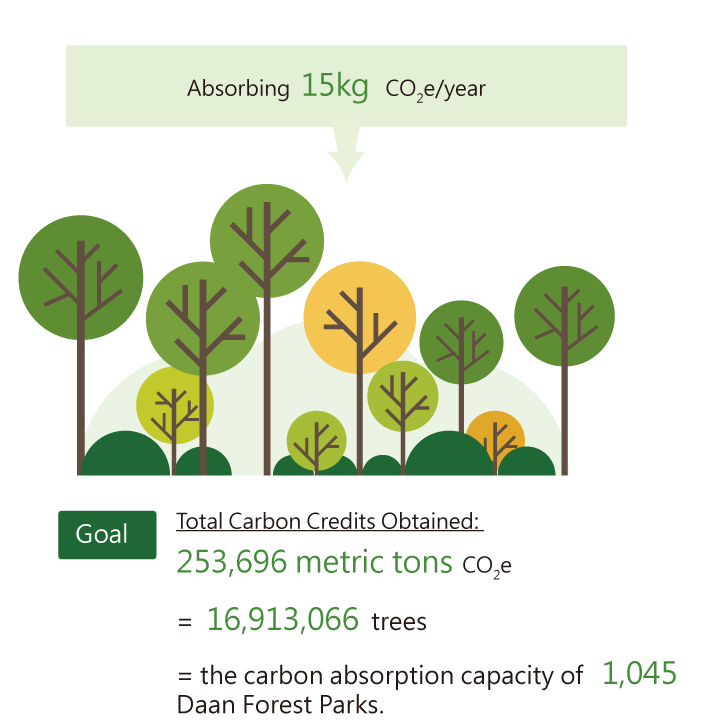
Recognizing carbon quota allocation as a future trend, CHS implemented the “Replacement Project: Using Natural Gas to Replace Fuel Oil in Reheating Furnaces,” and between 2019 and 2022, obtained 253,696 metric tons of CO₂ equivalent emission reductions, equivalent to the annual carbon absorption of 1,045 Daan Forest Parks. The acquired carbon credits can be used for offsetting carbon fees, environmental impact assessment (EIA) increases, or traded via the carbon exchange platform, thus generating additional profit for the Company.
Internal carbon pricing
In alignment with the “Regulations Governing the Collection of Carbon Fees” issued by the Ministry of Environment, the Company has established an internal carbon pricing (ICP) of NT$300 per metric ton as a corporate carbon reduction governance tool. This pricing is applied to calculate carbon-related costs and evaluate the benefits of capital expenditures associated with emissions reduction. This mechanism enables CHS to realistically assess the cost of decarbonization under a future net-zero pathway, thereby facilitating continuous improvement and enhancement of internal carbon reduction performance to achieve energy saving, emissions reduction, and sustainable development goals.
Internal carbon pricing
In alignment with the “Regulations Governing the Collection of Carbon Fees” issued by the Ministry of Environment, the Company has established an internal carbon pricing (ICP) of NT$300 per metric ton as a corporate carbon reduction governance tool. This pricing is applied to calculate carbon-related costs and evaluate the benefits of capital expenditures associated with emissions reduction. This mechanism enables CHS to realistically assess the cost of decarbonization under a future net-zero pathway, thereby facilitating continuous improvement and enhancement of internal carbon reduction performance to achieve energy saving, emissions reduction, and sustainable development goals.
The annual CO2 absorption capacity of Daan Forest Park is calculated at 242.6 metric tons.