Response to Climate Change
In March 2022, the National Development Council released the "Taiwan 2050 Net-Zero Emissions Pathway and Strategy," aiming to achieve net-zero emissions by 2050 through the integration of industry, government, and academia. In response to the global trend towards net-zero emissions and the increasing impact of climate change, CHS has committed to minimizing the risks associated with climate change and actively discloses climate change management actions and information to stakeholders. CHS has joined the TCFD Supporter initiative, launched by the Financial Stability Board (FSB), and discloses information on governance, risk management, strategy, metrics, and targets in its sustainability report.
CHS's TCFD Four Core Elements Actions
- CHS establishes the Risk Management Team and Sustainable Development Committee to oversee climate-related issues, with annual reporting to the Board of Directors on outcomes.
- The Company's climate-related financial disclosures were jointly compiled by the heads and members of the implementation teams under the Sustainable Development Committee.
Corresponding Chapter
- 2.3.4 Risk Management
- 1.2 Sustainable Development Committee
- CHS establishes "Risk Management Policy and Procedure Guidelines" to effectively manage climate change risks, specifying the implementation procedures and responsibilities of each unit.
- The Company has established a climate change risk and opportunity identification process based on the TCFD framework. This involves cross-departmental discussions and external information gathering to assess climate risks and opportunities faced by CHS. We evaluate their criticality by multiplying the factors of vulnerability (likelihood of occurrence), impact severity, and probability of occurrence.
Corresponding Chapter
- 2.3.4 Risk Management
- 5.2 Response to Climate Change
- The Company references the Intergovernmental Panel on Climate Change (IPCC) scenarios of RCP2.6 for climate mitigation and RCP8.5 for high greenhouse gas emissions to conduct financial impact assessments on "water scarcity." Additionally, it refers to scenarios from the International Energy Agency (IEA) such as the Stated Policies Scenario (STEPS) and the Net Zero Emissions (NZE) scenario to assess financial impacts related to "stricter carbon regulations and carbon pricing."
- CHS integrates the expertise of departmental managers and specialists through cross-departmental discussions to propose and implement effective strategies in response to various risks and opportunities.
Corresponding Chapter
- 5.2 Response to Climate Change
- ‧Greenhouse Gas Emission Targets:
The Company uses the base year of 2018, with total Scope 1 and Scope 2 greenhouse gas emissions amounting to 379,254 metric tons of CO2e. Targets include a 7% reduction by 2025, a 25% reduction by 2030, a 50% reduction by 2040, and achieving carbon neutrality by 2050. - Energy Conservation Target:
Cumulative Average Annual Electricity Savings Rate > 1.5% for the Period 2015-2025
Cumulative Average Annual Electricity Savings Rate > 1.6% for the Period 2015-2030
Cumulative Average Annual Electricity Savings Rate > 2% for the Period 2015-2050 - Target for wastewater (including process water) recycling rate:
2025: Wastewater (including process water) recycling rate > 99.1%
2030: Wastewater (including process water) recycling rate > 99.2%
2050: Wastewater (including process water) recycling rate > 99.3% - Renewable Energy Usage Target:
CHS Corporation's obligation for aggregated calculation of renewable energy green power among major electricity consumers requires an annual consumption exceeding 5,547,100 kilowatt-hours.
Corresponding Chapter
Detailed Information and Achievement in 2024:
- Greenhouse gas emissions, energy conservation rate, and wastewater (including process water) goals are detailed in Section 1.1 of CHS's Sustainability Targets under its sustainable development policies and targets.
- The renewable energy usage targets are detailed in Section 5.3.1 2024 Major Energy Conservation and Carbon Reduction Initiatives and Performance of the Carbon Reduction Pathway
Climate Governance Framework and Risk Management Process
| Board of Directors | The Board convenes annually to oversee the implementation status of climate-related strategies and goals. |
|---|---|
| Risk Management Team | Annually initiates risk identification, with outcomes presented by the convener (President) to the Board, including assessments conducted by the Sustainable Development Committee following the TCFD framework. Further operational details are outlined in Section 2.3.4 Risk Management. |
| Sustainable Development Committee | Coordinate various sustainability goals and promotion initiatives for CHS, ensuring alignment with the TCFD framework to assess climate-related risks and opportunities. Facilitate respective units in developing strategies to address these issues and impacts. Present annual outcomes to the Board through the Risk Management Committee. Refer to Organizational Chart 1.2 for details on the Sustainable Development Committee. |
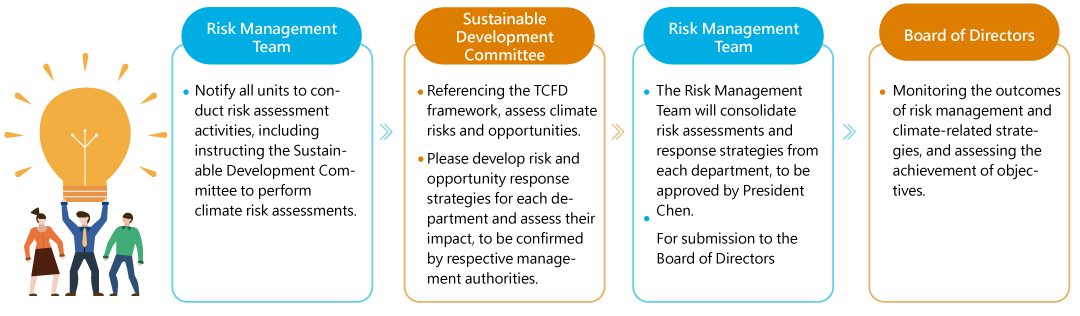
Process for Identifying Climate Risks and Opportunities

CHS Climate Risk Matrix
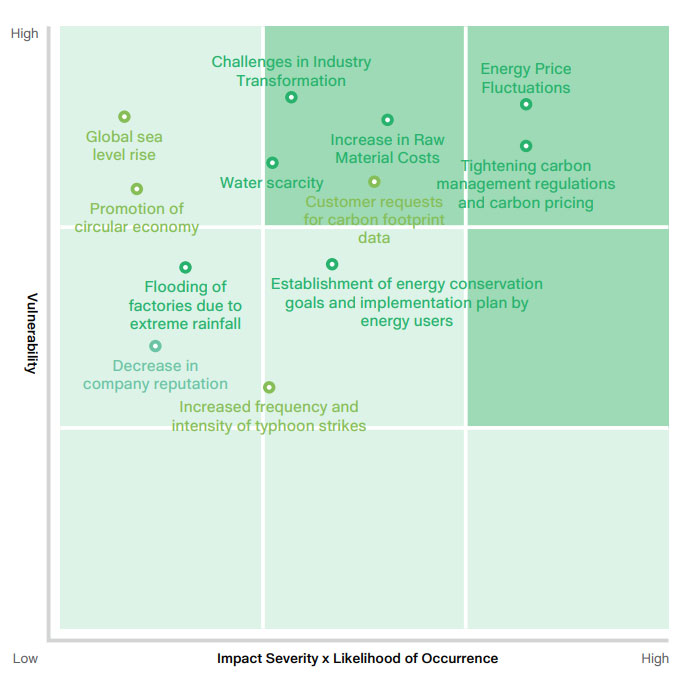
2.Vertical Axis - Vulnerability: Assess the company's readiness and adaptability to the risk if it occurs.
3.The dark green area represents highly critical climate risks. Details regarding their financial impacts and response strategies are as follows.
CHS Climate Opportunity Matrix
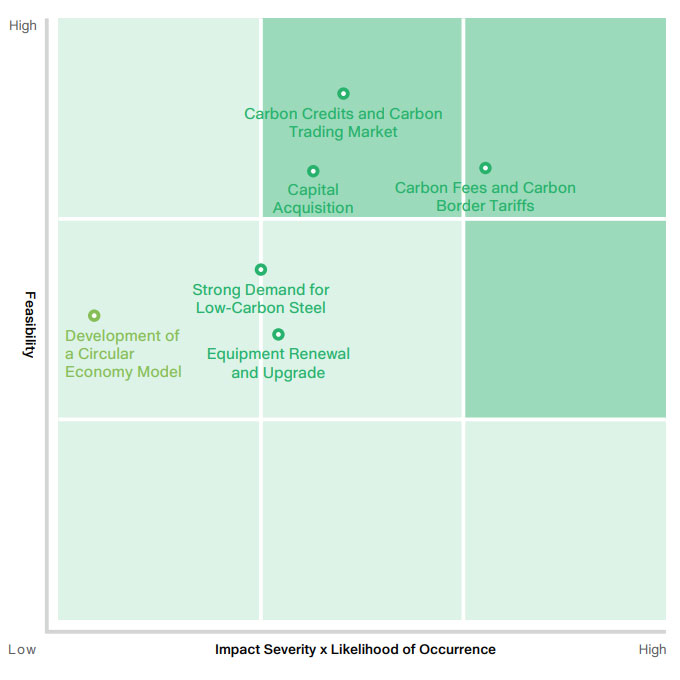
2.Vertical Axis - Degree of Control: Assess the Company's preparedness to create a competitive advantage if the opportunity occurs.
3.The dark green area represents highly critical climate opportunities. Details regarding their financial impacts and response strategies are as follows.
CHS's Highly Critical Climate Risks and Response Strategies
| Item No. | Risk Type | Risk Factor | Risk Impact | Financial Impact | Potential Occurrence Timeframe | Response Strategies | Impact Scope | ||
|---|---|---|---|---|---|---|---|---|---|
| Upstream | CHS | Downstream | |||||||
| 1 | Transition Risk - Regulatory Policies | Energy Price Fluctuations | Due to the government's policy of replacing nuclear power with renewable energy and substituting coal with natural gas, the cost of electricity generation per kilowatt-hour will significantly increase, leading to higher electricity procurement costs for the Company. | Using the projected total electricity costs for 2024, the future increase in electricity expenses will account for 0.97% of total revenue. | Short-term |
|
|||
| 2 | Transition Risk - Regulatory Policies | Tightening carbon management regulations and carbon pricing | Taiwan has started charging carbon fees since January 1, 2025, and global carbon taxes are being progressively implemented. These developments will increase the Company's operating costs. | Based on an estimated carbon fee of NT$300 per metric ton, the expenditure will account for approximately 0.24% of total revenue. | Short-term |
|
|||
| 3 | Transition Risk - Market | Increase in Raw Material Costs | To reduce carbon emissions, suppliers are incurring higher costs, leading to an increase in raw material prices and subsequently raising the Company's operating costs. | The projected increase in raw material costs is estimated to account for approximately 1.05% of total revenue. | Short-term |
|
|||
| 4 | Transition Risk - Technology | Challenges in Industry Transformation | To achieve sustainable development, the Company needs to move towards developing green products and improving green processes. This requires investment in research and development, manpower, time, and equipment, all of which will increase operating costs. | The costs associated with related research and equipment investment are estimated to account for approximately 0.62% of total revenue. | Long-term |
|
|||
| 5 | Transition Risk - Market | Customer requests for carbon footprint data. | Due to the global trend of carbon taxation, customers have requested CHS to provide product carbon footprint data. Failure to do so may reduce customers’ willingness to purchase, thereby impacting operating revenue. | If the Company is unable to fulfill customer requests for product carbon footprint information, it is estimated that the resulting loss may account for approximately 15.26% of total revenue. | Mid-term |
|
|||
| Item No. | Risk Type | Risk Factor | Risk Impact | Financial Impact | Potential Occurrence Timeframe | Response Strategies | Impact Scope | ||
|---|---|---|---|---|---|---|---|---|---|
| Upstream | CHS | Downstream | |||||||
| 1 | Immediate Physical Risks | Water scarcity | Climate change has caused uneven distribution of rainfall and prolonged periods of drought, resulting in water restrictions or shortages at various factory sites. This has led to operational disruptions on some production lines, impacting business operations. | The estimated daily losses due to water shortages for CHS are approximately 0.04% of total revenue. | Short-term |
|
|||
- Short-term: incidents occurring within 1-3 years; Medium-term: incidents occurring within 3-5 years; Long-term: incidents occurring beyond 5 years.
- Upstream refers to suppliers, while downstream refers to customers and consumers.
CHS's Highly Critical Climate Opportunities and Response Strategies
| Item No. | Opportunity Types | Opportunity Factors | Opportunity Impact | Financial Impact | Potential Occurrence Timeframe | Response Strategies | Impact Scope | ||
|---|---|---|---|---|---|---|---|---|---|
| Upstream | CHS | Downstream | |||||||
| 1 | Market | Carbon Credits and Carbon Trading Market | With the launch of Taiwan's domestic carbon trading platform on October 2, 2024, carbon credits obtained by the Company can generate additional profits through market transactions. | Based on the obtained carbon credits for CHS, the potential profit could amount to approximately 0.25% of total revenue. | Mid-term |
|
|||
| 2 | Market | Carbon Fees and Carbon Border Tariffs | Beginning January 1, 2025, Taiwan will impose a domestic carbon fee. Simultaneously, countries around the world are successively implementing the Carbon Border Adjustment Mechanism. If CHS’s steel products emit less carbon than competitors’, its sales will become more competitive in the future. | CHS continues to reduce product carbon footprint and secure market presence in these relevant countries, with sales estimated to contribute approximately 0.67% to total revenue. | Short-term |
|
|||
| 3 | Market | Capital Acquisition | The international community is increasingly focusing on investments related to high-carbon industries, emphasizing companies that implement carbon reduction and low-carbon transformation. Such initiatives tend to attract attention and financial support from banks and investors. | Meeting sustainable requirements from banks typically results in preferential financing amounting to approximately 0.02% of total revenue. | Short-term |
|
|||
- Short-term: incidents occurring within 1-3 years; Medium-term: incidents occurring within 3-5 years; Long-term: incidents occurring beyond 5 years.
- Upstream refers to suppliers, while downstream refers to customers and consumers.
Climate Scenario Analysis
| Climate Risks | Climate Scenarios | Evaluation Content | |
|---|---|---|---|
| Physical Risks | Water scarcity | IPCC's RCP2.6 and RCP8.5 | Based on estimation and analysis, it is projected that CHS's production and operations will be impacted under both the RCP2.6 and RCP8.5 scenarios, resulting in a potential loss of operating revenue. In anticipation of potential scenarios of water scarcity, CHS has developed specific coping strategies and related objectives, detailed on page 62 of the CHS Highly Critical Climate Risks and Response Strategies in its ESG report. |
| Transition Risk | Tightening carbon management regulations and carbon pricing | The IEA's STEPS, NZE, and CHS's greenhouse gas reduction targets scenario analysis depict pathways for greenhouse gas emissions and reduction strategies leading up to 2050. | From the scenario analysis, it is evident that without proactive efforts in carbon reduction, CHS may face substantial carbon fees and penalties. However, if CHS implements its carbon reduction targets and achieves carbon neutrality by 2050, carbon fees and penalties will progressively decrease until they are no longer applicable. |